
Zygomatic Dental Implants for Severe Upper-Jaw Bone Loss
Zygomatic implants are longer implants anchored in the cheekbone. For selected patients with significant upper-jaw bone loss, they may offer an alternative to extensive bone grafting. Candidacy is decided only after an exam and imaging.
What Are Zygomatic Dental Implants?
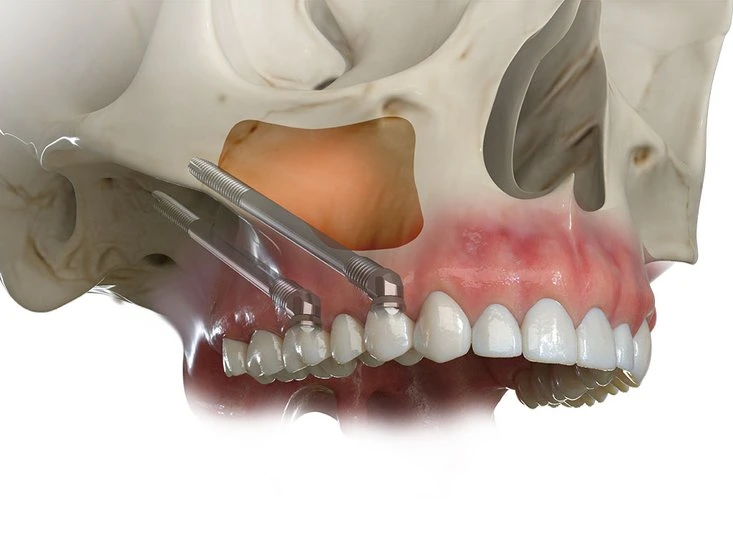
A zygomatic implant is a long dental implant that is anchored in the zygomatic bone, commonly called the cheekbone, instead of relying only on the upper jawbone. The part of the implant that holds your teeth emerges in the mouth, where it can support a fixed set of replacement teeth.
Zygomatic implants are an advanced treatment. They are generally considered for the upper jaw when bone volume is too limited for conventional implants, and they are typically used as part of a full-arch plan.
How Zygomatic Implants Anchor in the Cheekbone
After tooth loss, the upper jawbone can shrink over time, and the sinus cavities can sit closer to the ridge. This can leave too little bone in the back of the upper jaw for standard implants.
The cheekbone is dense bone that often remains intact in these situations. A zygomatic implant is angled from the upper jaw toward the cheekbone so that it engages this stronger bone. As with other implants, the bone then bonds to the implant surface over time, a process called osseointegration.
- The implant passes through or alongside the upper jaw area on its way to the cheekbone.
- Planning is done on a 3D scan so the path avoids important structures.
- Zygomatic implants are often combined with conventional implants at the front of the jaw.
Why They May Be Considered for Severe Upper-Jaw Bone Loss
Your doctor may discuss zygomatic implants if you have significant bone loss in the upper jaw, have had previous bone grafting that was not successful, or want to explore options that may reduce the need for extensive grafting.
They are not right for everyone. Your overall health, remaining bone, sinus anatomy, gum condition, and goals all affect whether this approach is appropriate.
Not a guaranteed solution
Zygomatic implants may not be suitable for every patient with bone loss, and they do not guarantee a particular outcome or timeline. Some patients are better served by other approaches.
Potential Alternatives to Extensive Bone Grafting
Bone grafting rebuilds lost bone so conventional implants can be placed. It can work well, but in some cases it adds extra procedures, healing time, and cost.
For selected patients, zygomatic implants may reduce or avoid the need for certain large grafting procedures in the upper jaw. This depends on your anatomy, and some patients may still need grafting or other preparation. Your doctor can explain the trade-offs for your situation.
- Bone grafting followed by conventional implants
- Conventional implants placed with a tilted or angled design
- Pterygoid implants in the back of the upper jaw
- Zygomatic implants anchored in the cheekbone
Treatment Planning and the Consultation Process
Your first step is a consultation. The team reviews your medical and dental history, examines your mouth, and typically takes 3D imaging to evaluate bone, sinuses, and anatomy.
If zygomatic implants may fit your needs, your doctor reviews the plan, benefits, risks, alternatives, expected recovery, and the estimated cost with you before you decide.
- Clinical examination and review of medical history
- 3D imaging such as cone beam CT
- Discussion of all options, including non-zygomatic approaches
- A written plan and estimate before treatment
Surgical Complexity, Recovery, and Possible Complications
Zygomatic implant placement is more technically complex than conventional implant surgery. It is typically performed with anesthesia or sedation as determined by your doctor, and it requires careful planning.
Recovery varies by patient. Swelling, soreness, and a modified diet are common early on, and your team will give you personalized instructions. Bone bonding to the implants takes time, and the timing of final teeth depends on your case.
- Swelling, bruising, discomfort, or bleeding after surgery
- Sinus-related problems such as sinusitis
- Infection or inflammation around the implants
- Numbness, tingling, or nerve irritation
- Implant failure or the need for additional procedures
- Changes to the plan if bone or anatomy differ from what imaging showed
When to call your dental office
Contact your treating office promptly if you notice fever, worsening pain or swelling, persistent nasal bleeding or congestion, or anything that concerns you after surgery.
Zygomatic vs. Conventional Dental Implants
| Consideration | Conventional implants | Zygomatic implants |
|---|---|---|
| Anchoring bone | Upper or lower jawbone | Cheekbone (zygomatic bone), often with jaw implants |
| Typical use | Patients with enough jawbone volume | Selected patients with significant upper-jaw bone loss |
| Bone grafting | May be needed if bone is limited | May reduce the need for some large grafts in selected cases |
| Surgical complexity | Lower in most cases | Higher, requires advanced planning |
| Candidacy | Determined by exam and imaging | Determined by exam and imaging; not suitable for everyone |
General comparison only. Your doctor determines the right approach for your anatomy and goals.
Continue Exploring
Pterygoid Implants
Another advanced option for the back of the upper jaw.
Options for Severe Bone Loss
Compare approaches when bone is limited.
Zygomatic vs. Traditional Implants
How the two approaches differ.
Why All-on-6
Our full-arch implant approach.
Office Locations
Oakton, Arlington and Manassas.
Dental Implant FAQ
More patient questions answered.
Find Out Whether Zygomatic Implants May Be an Option
Schedule a consultation for an exam and imaging so a doctor can review your bone, your goals, and all of your treatment options.
Ready to explore your options?
Find out if you may be a candidate — takes 60 seconds.